

Short answer: early-stage founders reach the right investors faster by narrowing first, then reaching out. Define your fit (sector, stage, market and check size), build a short list of investors whose thesis matches, make your startup profile complete and easy to evaluate, request introductions or connections with a personal note, and track every conversation in one place.
Most first-time founders approach fundraising as a numbers game. They buy or scrape a list of a few thousand investors, send the same email to all of them, and wait. Reply rates are tiny, and the few replies often come from investors who do not invest at that stage or in that sector anyway. Months pass, and the founder concludes that the market is not interested.
In reality, the market never saw a relevant pitch. Investors receive hundreds of unsolicited emails a week and filter aggressively by fit. If your startup does not match what they invest in, the quality of your email does not matter.
Why cold outreach fails for early-stage startups
- Wrong targets. Generic lists mix angels, seed funds, growth funds and corporate investors with completely different mandates.
- Missing context. A cold email has to explain everything in a few lines, and investors cannot quickly check the details.
- No trust signal. Without a warm introduction or a credible platform, an unknown founder’s email is easy to ignore.
- Founder time. Every week spent on mass outreach is a week not spent on customers, which is what investors want to see.
A better process in five steps
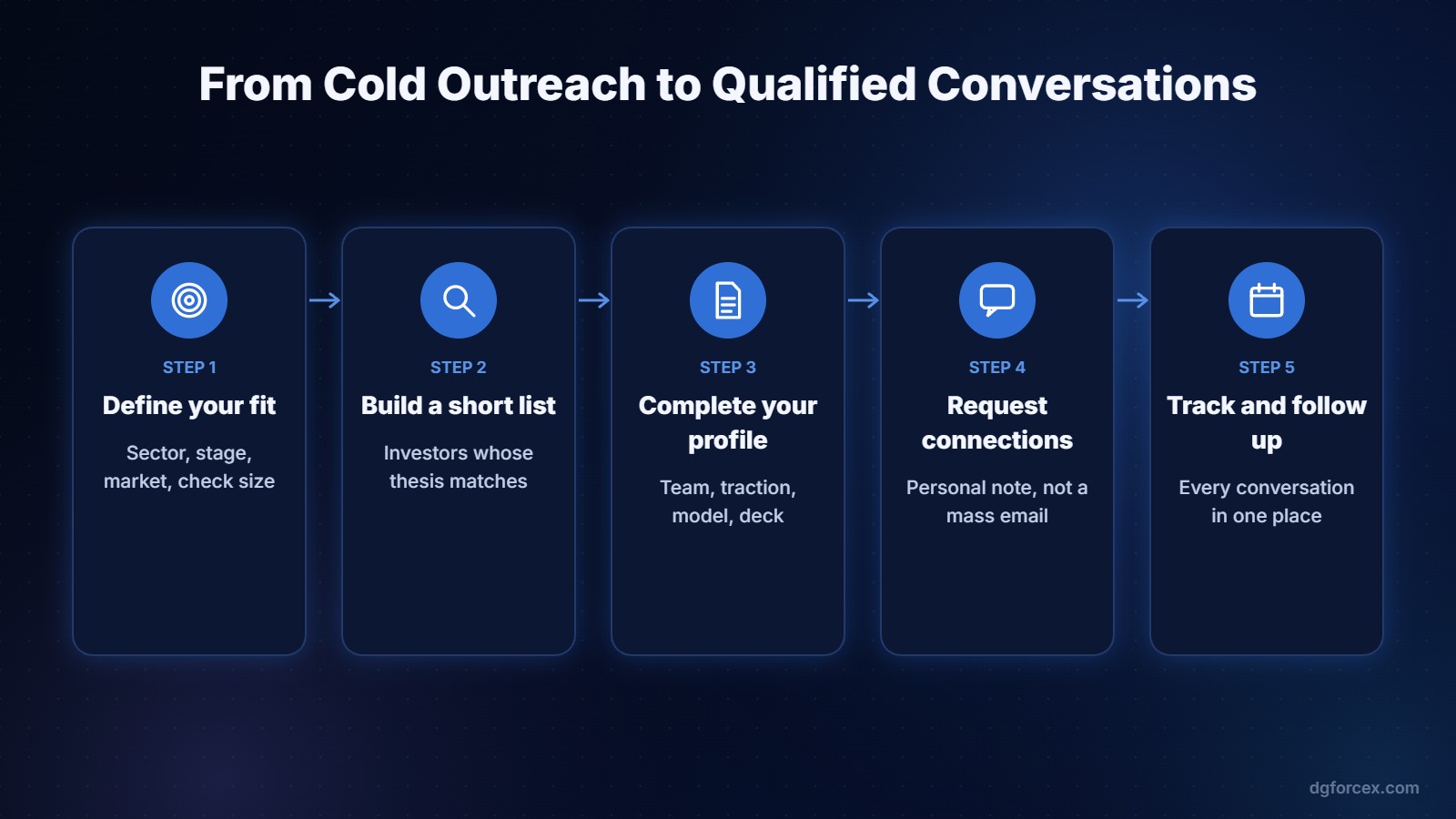
1. Define your fit
Write down your sector, stage, target market, business model and the amount you are raising. These five facts decide which investors can say yes. A pre-seed B2B SaaS company raising 500 thousand dollars has a very different investor universe from a Series A consumer app.
2. Build a short list
Look for investors who have recently invested in your sector and stage and who publish a thesis that includes you. Thirty well-matched investors are worth more than three thousand random ones. Note who in your network might know each of them.
3. Make your profile complete
Before reaching out, make sure an investor can evaluate you in five minutes: a clear one-line description, the team, the problem and solution, traction so far, the business model, the market, and a short deck. Investors who show interest will check, and gaps cost you momentum. If you are still before traction, read Not Every Startup Idea Deserves an MVP before you raise.
4. Request connections, personally
Ask for warm introductions where you can. Where you cannot, send a short, personal note that explains why this specific investor fits: their thesis, a related portfolio company, something they wrote. Keep it to a few sentences and link to your profile.
5. Track and follow up
Keep every conversation in one place with its status and next step. Follow up after meetings with the information you promised. Send short monthly updates to interested investors; progress over time is often what converts a “not yet” into a yes.
See it from the investor’s side
Investors use the same logic in reverse: they filter deal flow by thesis, stage and market before they read anything in depth. Understanding how they filter helps you present yourself in the way they search. We cover the investor’s view in Startup Deal Flow for Angel Investors: How to Filter by Thesis.
Using a curated platform instead of mass email
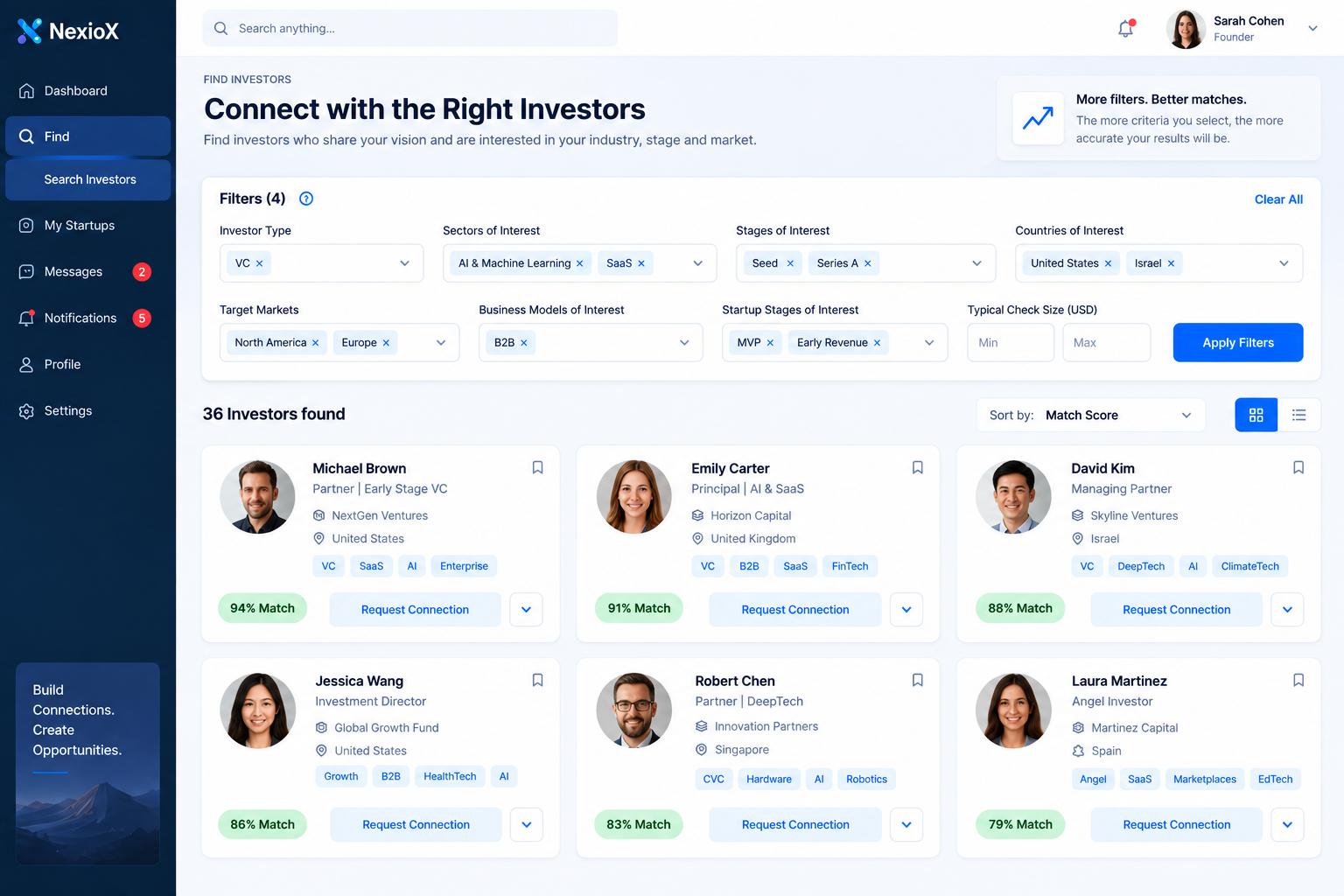
NexioX is a private platform where early-stage founders and investors find each other by sector, stage, market and investment interest. Founders create structured startup profiles covering team, stage, market and business model, with media, pitch materials and links, and can search and filter investors by criteria. Connections are requested inside the platform, and messaging opens only after a connection is accepted, with no public contact details and no unsolicited messages.
Get discovered by investors who fit
Publish a structured startup profile and connect with investors by sector, stage and market.
Ready to publish your startup? Join NexioX.
FAQ
How many investors should a founder contact?
Start with a short list of 30 to 50 well-matched investors rather than thousands of random ones. Expand only if the first round of conversations shows a clear pattern.
Do cold emails to investors ever work?
Sometimes, when they are short, personal and clearly matched to the investor’s thesis. Mass emails rarely do.
What do investors check first?
Fit with their thesis (sector, stage, market), then the team, traction and the business model.
Is a warm introduction always better?
Usually, because it adds trust. A curated platform with verified profiles can provide a similar signal when you have no mutual contact.
When should a founder start fundraising?
When you can show evidence that the problem is real and your solution works, even if early. Raising before that is possible but much harder.

DGforceX is a digital growth Hub. We combine marketing strategy, AI, web development and cyber risk expertise to help businesses build, grow and protect their digital presence.