
Short answer: to measure B2B revenue by campaign, capture the source and campaign on every lead, carry it through to the opportunity and the closed deal in your CRM, and put ad spend from each platform next to the pipeline and revenue that campaign produced. Then compare campaigns on cost per opportunity and return on spend, not on cost per lead.
Ask a B2B marketing team which campaign worked best last quarter and you will usually hear about leads: this webinar brought 400 sign-ups, that LinkedIn campaign delivered leads at half the cost. Ask which campaign produced the most revenue and the room gets quiet. The data exists, but it lives in three places that do not talk to each other: the ad platforms, the website analytics and the CRM.
The result is predictable. Budgets flow to campaigns that generate cheap leads, while campaigns that generate fewer but better leads get cut. Sales complains about lead quality, marketing points at the volume, and nobody can prove who is right.
Why cost per lead is the wrong scoreboard
Cost per lead rewards volume. A gated report promoted to a broad audience will almost always beat a demo campaign aimed at decision makers on cost per lead, and lose to it badly on revenue. Long B2B sales cycles make it worse: the deal that a campaign generates may close four or six months later, long after the budget decision was made.
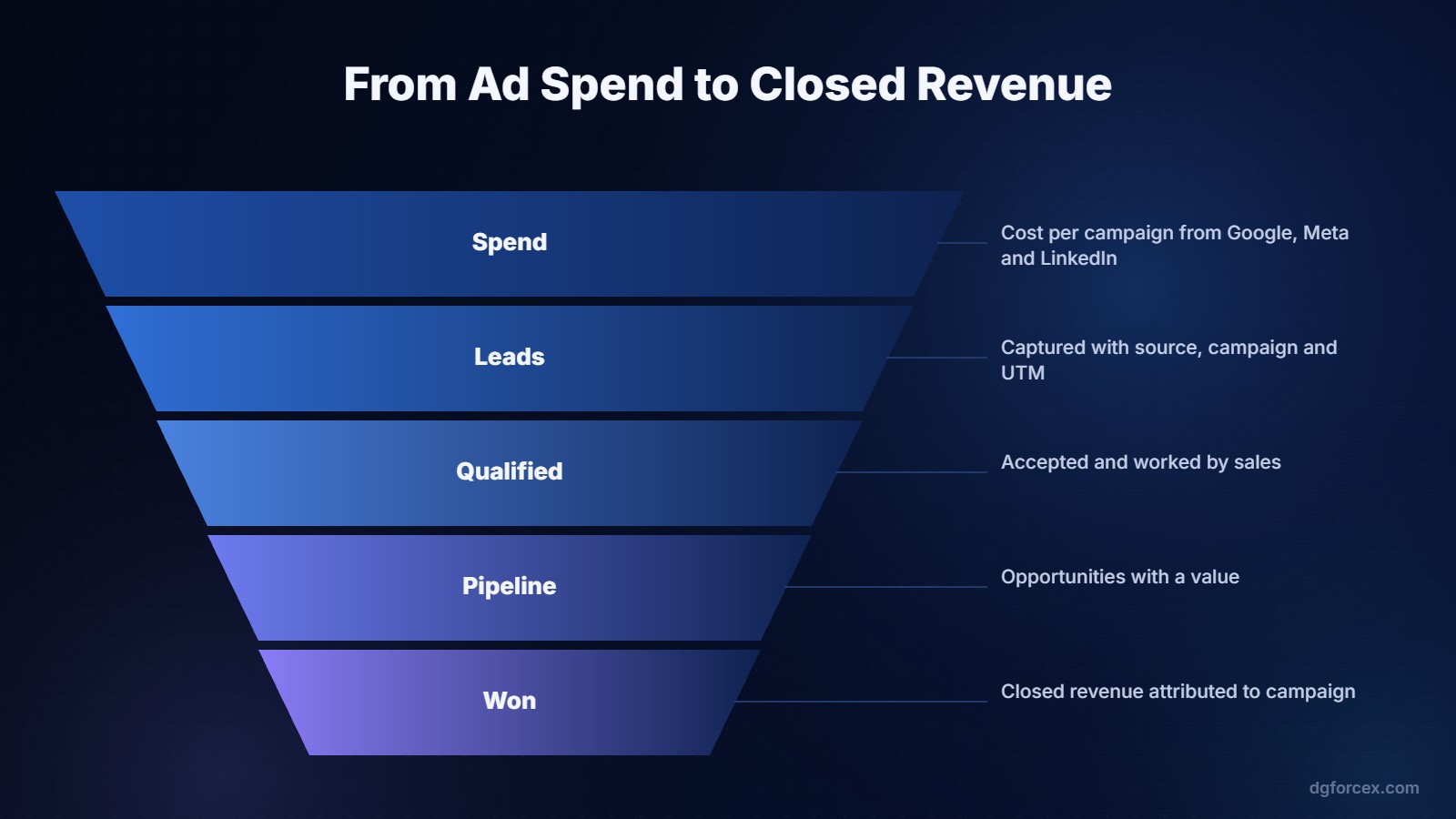
What you actually want to know for each campaign is:
- How much did we spend?
- How many leads became qualified opportunities?
- How much pipeline value did those opportunities create?
- How much of it closed, and how long did it take?
The data you need to connect
1. Clean source and campaign data on every lead
Use consistent UTM parameters on every paid link and make sure your forms pass them into hidden CRM fields: original source, campaign and, where possible, content. Agree on naming rules (lowercase, no spaces, one name per campaign) and document them. Most attribution problems start here, with campaigns named three different ways.
2. Carry the campaign to the opportunity
Leads convert into contacts and opportunities. If the campaign field does not follow them, the trail ends at the lead stage. In HubSpot this usually means associating deals with the original contact source; in Salesforce, campaign influence or a primary campaign field on the opportunity; in Pipedrive, a custom field copied at conversion.
3. Bring in the cost
Spend lives in Google Ads, Meta Ads and LinkedIn Ads. Export cost by campaign for the same period, using the same campaign names as your UTMs. Without cost next to revenue, you can rank campaigns but you cannot judge return.
4. Choose a simple attribution model and stick to it
First touch shows which campaigns create new demand. Last touch shows which campaigns close it. For most teams, starting with first touch for pipeline creation is enough. Multi-touch models are useful later, but only once the basic data is clean. Changing models every quarter makes trends meaningless.
The four numbers to compare campaigns on
- Cost per qualified opportunity: spend divided by opportunities accepted by sales.
- Pipeline per dollar spent: total opportunity value divided by spend.
- Closed-won revenue and return on ad spend: revenue that actually closed against the cost.
- Time to close: some campaigns produce revenue fast, others slowly. Both can be valuable, but you need to know which is which.
Report these numbers monthly with a rolling six or twelve month window, so slow-closing deals still get credited to the campaign that created them.
Lead quality and lead handling are two different problems
Before you blame a campaign for poor revenue, check what happened to its leads. A campaign can produce excellent prospects that were never called back. If one source shows weak conversion, look at response time and follow-up for those specific leads first. Our guide to a lead response time audit walks through exactly how to check that.
Putting it in one view
Doing this by hand means exporting from four systems every month and stitching spreadsheets together. It works for a quarter or two, then the process breaks when someone renames a campaign. If you are planning the wider tooling, our article on building an AI-first marketing stack for B2B covers how the pieces fit together.
Metriflow does the stitching automatically. It connects read-only to HubSpot, Salesforce or Pipedrive, pulls cost from Google Ads, Meta Ads and LinkedIn Ads, and reads GA4. Pipeline and closed-won revenue appear by source and campaign, with paid spend shown alongside, and the AI insights layer summarizes each dashboard and answers questions such as which campaign produced the most pipeline this quarter. Pricing is a fixed monthly price by team size, not per user.
See which campaigns create revenue
Connect your CRM and ad accounts once and get pipeline and revenue by campaign, with spend alongside.
Prefer to try it directly? Sign up for Metriflow.
FAQ
What is campaign revenue attribution?
It is the process of crediting closed revenue and pipeline to the marketing campaign that created or influenced each deal, so you can compare campaigns on business results instead of lead volume.
Which attribution model should a B2B team start with?
Start with first-touch attribution for pipeline creation. It is simple, stable and shows which campaigns bring new demand. Add multi-touch later once your data is clean.
Why do UTM parameters matter for revenue reporting?
UTMs are how a lead’s campaign gets recorded. If they are missing or inconsistent, the link between spend and revenue breaks at the first step.
How long should the reporting window be?
Use a rolling window at least as long as your average sales cycle, usually six to twelve months, so slow deals are still credited to their campaign.
Is cost per lead useless?
No, it is a useful early signal, but it should never be the final measure. Judge campaigns on cost per opportunity and revenue.

DGforceX is a digital growth Hub. We combine marketing strategy, AI, web development and cyber risk expertise to help businesses build, grow and protect their digital presence.