
Short answer: employee advocacy on LinkedIn works when it is a light, repeatable system: choose five to ten willing employees, give them ready drafts based on company news and their own expertise, let each person rewrite the draft in their own voice, schedule a steady cadence of one or two posts a week, and review reach and engagement monthly.
Company pages on LinkedIn reach a fraction of the people that individual profiles do. Posts from real people, especially people with expertise, get more reach, more comments and more trust than the same message from a logo. Most companies know this, launch an employee advocacy initiative with enthusiasm, and watch it fade within two months.
It usually fades for practical reasons, not lack of goodwill. Employees do not know what to write, writing takes time they do not have, and the content they are asked to share sounds like a press release.
Why employee advocacy programs stall
- Blank page problem. “Please post more on LinkedIn” is not a brief. People need topics and drafts.
- Corporate tone. Copy-paste company announcements read as ads and perform poorly on personal profiles.
- No rhythm. A burst of posts around a launch, then silence for six weeks.
- No feedback. Nobody tells participants what worked, so motivation drops.
An employee advocacy system in four steps
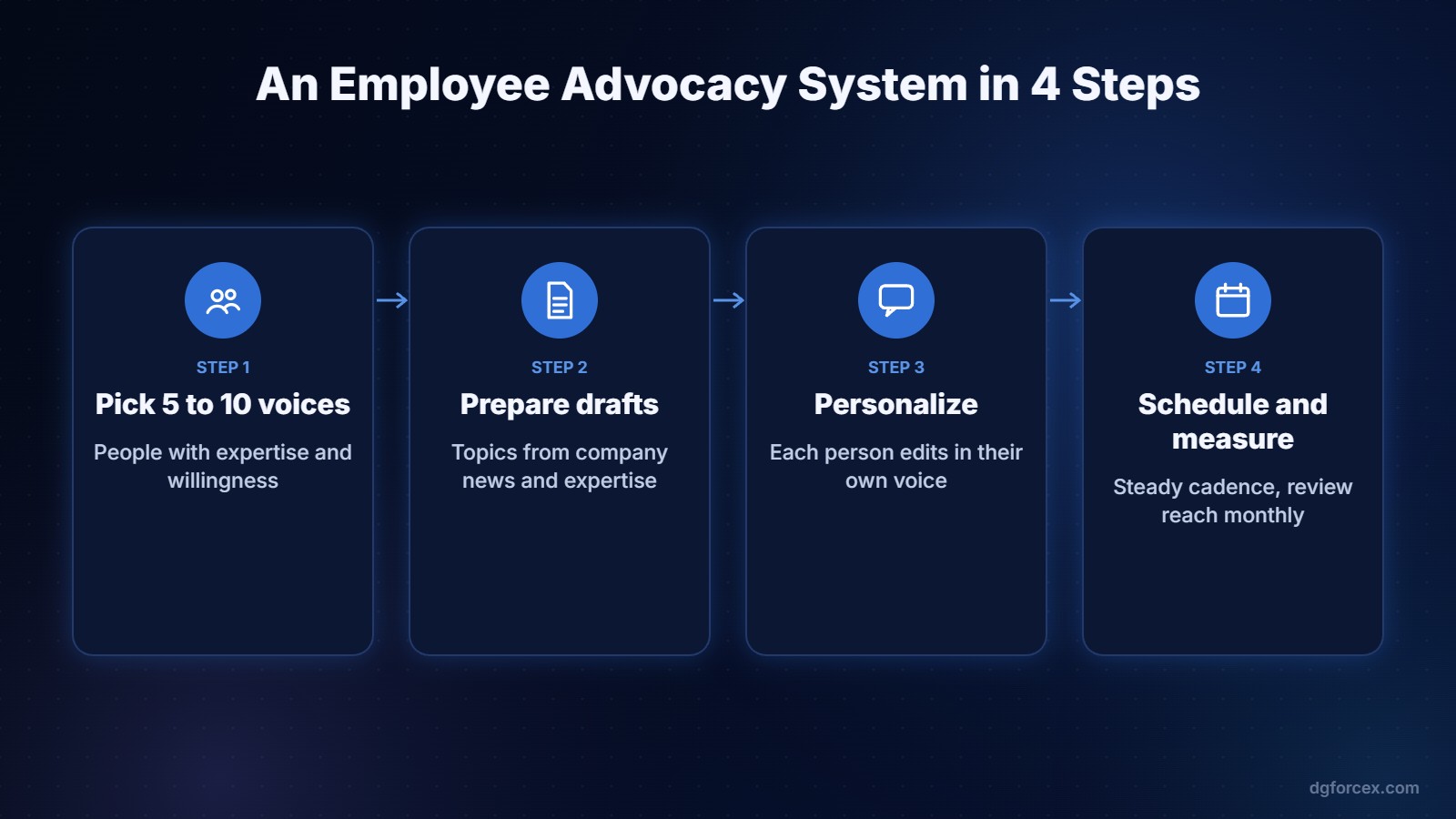
1. Pick five to ten voices
Start small with people who have real expertise and some willingness: a founder, a product lead, a senior engineer, a customer success manager, a sales leader. Variety of perspective matters more than seniority. Ask, do not assign.
2. Prepare drafts, not instructions
Each week, prepare one draft per person based on two kinds of input: company news (launches, events, hires, customer stories) and the person’s own expertise (lessons, opinions, how they solved a problem). Expertise posts usually outperform news posts, so aim for a mix weighted toward them.
3. Let each person make it their own
The draft is a starting point. Each person edits it into their own voice, adds a personal detail, or rejects it. A post that sounds like the person who published it will always beat a perfect corporate paragraph. Write drafts in the first person and keep them short.
4. Schedule a steady cadence and measure
One or two posts per person per week, spread across the team so the company appears in feeds every working day. Once a month, share a short summary with participants: total reach, the best-performing posts and why they worked. Recognition keeps people in the program.
What employees should post about
- A problem they solved this week and what they learned.
- A customer story told from their own role.
- A behind-the-scenes view of a launch or event.
- An opinion on an industry trend, with a clear point of view.
- A useful resource or tool, explained in their own words.
Guardrails that keep it safe
Write a one-page guideline: what is confidential, how to talk about customers, and who to ask when unsure. Keep it short and trusting. Heavy approval processes are the fastest way to kill participation.
Scaling employee advocacy with the right tools
Preparing personalized drafts for ten people every week is the part that breaks first. It is also the part that benefits most from AI, provided the AI understands both the company’s voice and each person’s style. The same principles apply as when you manage several company brands, which we explain in Managing Social Media for Multiple Brands Without Losing Each Brand’s Voice.
Post Machine, the platform we build at DGforceX, supports this workflow. It plans and writes posts from company content, generates on-brand images, keeps each brand’s voice consistent, and publishes on schedule to LinkedIn, Facebook and Instagram, with employee advocacy and analytics built in. We set it up and customize it for each organization, so it fits your approval process and your team.
Make employee advocacy a habit, not a campaign
Post Machine is built and customized by DGforceX for each organization. Tell us how many people and brands you want to include.
Already using it? Open the Post Machine app.
FAQ
What is employee advocacy?
Employee advocacy is when employees share company news and their own professional expertise on their personal social profiles, extending the company’s reach and credibility.
How often should employees post on LinkedIn?
One or two posts per week per person is sustainable for most people and enough to build visibility over time.
Should employees post company content word for word?
No. Drafts should be edited into each person’s voice. Identical posts from many employees look coordinated and perform poorly.
How do you measure employee advocacy?
Track reach, engagement and profile views per participant, plus website visits and leads from employee posts where you can tag links.
How many employees should start the program?
Five to ten motivated people is a good start. Grow the group once the first participants see results.

DGforceX is a digital growth Hub. We combine marketing strategy, AI, web development and cyber risk expertise to help businesses build, grow and protect their digital presence.