Introduction
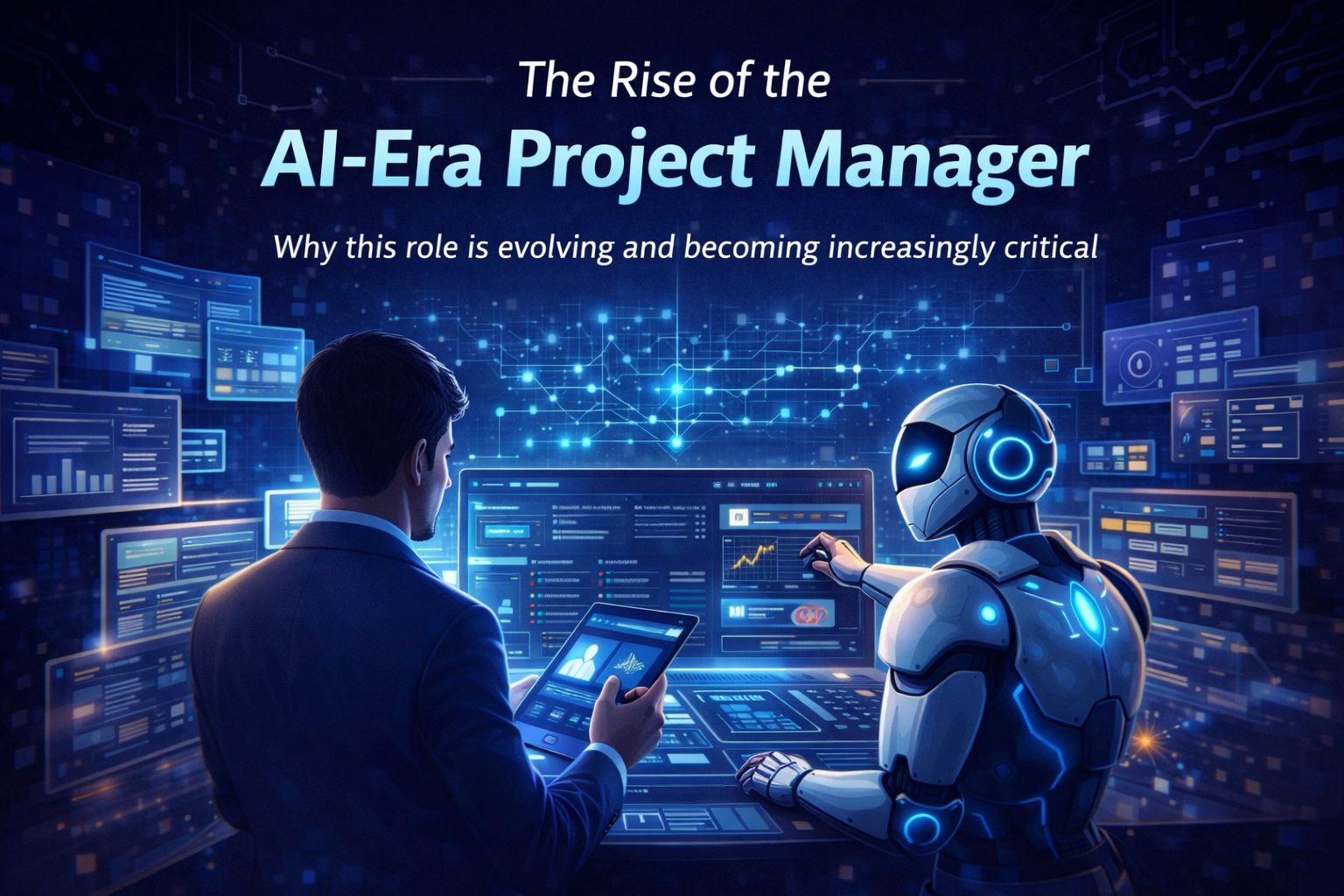
Project management has always been a critical discipline inside organizations. But in the age of AI, the expectations from project managers are changing rapidly.
Today, companies are not just looking for people who can track tasks and run meetings. They are looking for operators who understand technology, automation, and AI-driven workflows, and who can translate business needs into structured, executable systems.
At the same time, a new gap is emerging.
As AI tools become widely accessible, many organizations assume that anyone who knows how to use AI can step into a project management role.
In some cases, especially in smaller teams or simpler workflows, this can work well. AI tools can help individuals manage tasks, automate processes, and maintain visibility without deep project management experience.
However, as projects grow in scale and complexity involving multiple stakeholders, systems, dependencies, and structured processes the need for professional project management becomes significantly more important.
Project management is a discipline built on methodologies, structured thinking, leadership skills, communication frameworks, and years of practical experience. While AI enhances execution and efficiency, managing complex environments still requires a deep understanding of how to align people, processes, and outcomes toward a common goal.
The real opportunity lies in the combination.
When professional project management expertise is combined with AI tools and automation systems, the result is a powerful new model of work one where project managers move beyond coordination and become architects of intelligent, scalable workflows.
Traditional Project Management
Traditional project management has always been built around coordination.
The project manager served as the central hub connecting stakeholders, teams, timelines, and deliverables. Their responsibilities typically included:
• Defining project scope and objectives
• Managing timelines, milestones, and dependencies
• Coordinating cross-functional teams and resources
• Monitoring risks, blockers, and delivery constraints
• Communicating updates to stakeholders and leadership
A large portion of the work involved tracking progress and reporting outcomes.
Project managers spent significant time collecting updates from different teams, reviewing task completion, and preparing reports for leadership. Measuring time spent on activities, evaluating project performance, and estimating return on investment (ROI) often required manual data gathering across multiple tools, spreadsheets, and communication channels.
These operational tasks were essential but time-consuming and often repetitive.
Much of the project manager’s effort went into maintaining visibility, ensuring alignment, and keeping information up to date, rather than actively improving how the work itself was executed.
The Shift: AI-Augmented Project Management
AI tools can now handle many of the tasks that used to consume a large portion of a project manager’s time.
Modern platforms can:
• Automatically track project progress across tools
• Generate real-time status reports and summaries
• Transcribe and summarize meetings into action items
• Predict delivery delays based on historical patterns
• Identify risks and bottlenecks before they escalate
• Suggest workflow improvements and optimizations
In other words, AI is increasingly managing the operational layer of project tracking and reporting.
This shift allows project managers to move up the value chain.
Instead of focusing on coordination and reporting, they can now concentrate on:
• Designing efficient and scalable workflows
• Integrating tools, APIs, and automation systems
• Interpreting AI-generated insights and recommendations
• Aligning execution with business strategy and KPIs
• Driving outcomes rather than tracking activity
The role is evolving from project coordinator to system orchestrator.
Why Companies Are Looking for AI-Savvy Project Managers
AI Improves Efficiency and Reduces Operational Costs (Expanded)
One of the most impactful advantages of AI-driven project management is efficiency at scale.
AI reduces the need for manual coordination, repetitive reporting, and administrative overhead. Tasks that previously required multiple people such as data collection, status tracking, and documentation can now be automated.
As a result, companies can often operate with leaner teams while maintaining or even improving output quality.
AI-enabled project managers play a key role in designing these systems. They identify where automation can replace manual work, optimize resource allocation, and ensure that teams focus only on high-value activities.
This leads to measurable outcomes:
• Faster delivery cycles
• Reduced operational costs
• Improved team productivity
• Better decision-making through real-time data
The New Skillset of the AI-Era Project Manager
The modern project manager combines traditional leadership skills with technical fluency and a forward-thinking mindset.
Systems Thinking
The ability to understand how multiple systems interact including tools, data flows, teams, and automation layers.
Project managers must see the entire ecosystem, not just individual tasks, and design workflows that optimize the system as a whole.
AI Literacy
A deep understanding of how AI tools work, what they are capable of, and where their limitations lie.
This includes knowing when to trust AI outputs, when to validate them, and how to integrate AI into real workflows effectively.
Workflow Automation
The ability to design and implement automation across tools and processes.
This includes connecting platforms, defining triggers, building workflows, and reducing manual work wherever possible.
Data-Driven Decision Making
Project managers must be comfortable working with dashboards, analytics, and AI-generated insights.
They need to translate data into decisions prioritizing tasks, reallocating resources, and adjusting timelines based on real-time information.
Human Leadership
Even in an AI-driven environment, leadership remains critical.
Project managers must align teams, resolve conflicts, communicate clearly, and maintain motivation and accountability.
Entrepreneurial Approach
Modern project managers act like internal entrepreneurs.
They don’t just manage projects, they improve them.
They proactively identify inefficiencies, experiment with new tools, and drive innovation in how work is executed.
Self-Learning Drive (Autodidact Mindset)
AI evolves rapidly. The tools used today may be outdated in months.
Successful project managers continuously learn, explore new platforms, test workflows, and stay ahead of technological changes.
Adaptability and Change Management
The ability to adapt quickly to new tools, processes, and environments is essential.
Project managers must guide teams through change, implement new systems smoothly, and ensure adoption across the organization.
AI Tools Transforming Project Management
AI is not replacing project managers, it is becoming one of their most powerful enablers.
ClickUp AI
https://clickup.com
An all-in-one productivity and project management platform with built-in AI for task creation, documentation, reporting, and workflow automation.
Ideal for teams looking to centralize operations in one system.
Notion AI
https://www.notion.so
A flexible workspace that combines documentation, project management, and knowledge bases with AI-powered writing, summarization, and organization.
Great for startups and product teams.
Asana Intelligence
https://asana.com
AI-powered project insights, risk detection, and prioritization tools integrated into one of the most widely used project management platforms.
Monday AI
https://monday.com
A highly customizable workflow platform with AI features for automation, reporting, and process management across departments.
Motion
https://www.usemotion.com
An AI scheduling tool that automatically plans tasks into your calendar based on priorities, deadlines, and workload.
Height AI
https://height.app
An AI-native project management tool that automates task management, identifies blockers, and updates workflows in real time.
Custom AI Project Management Tools (New Approach)
Beyond off-the-shelf tools, companies can now build custom project management systems tailored to their workflows.
Using modern AI development environments and “vibe coding” platforms, teams can create internal tools that match their exact processes.
This includes:
• Custom dashboards
• Automated workflows
• Internal AI assistants
• Integrated business logic
You can explore these platforms here:
https://dgforcex.com/hub/
The Future of Project Management
Project management is no longer just about managing tasks.
It is about managing systems of work.
The most valuable project managers in the AI era will be those who can design, optimize, and orchestrate complex environments where humans and AI work together seamlessly.

Ariel Gal is a digital strategist specializing in scalable web platforms, SEO architecture, automation, and AI-enabled growth. His work focuses on turning complex digital systems into reliable business infrastructure.