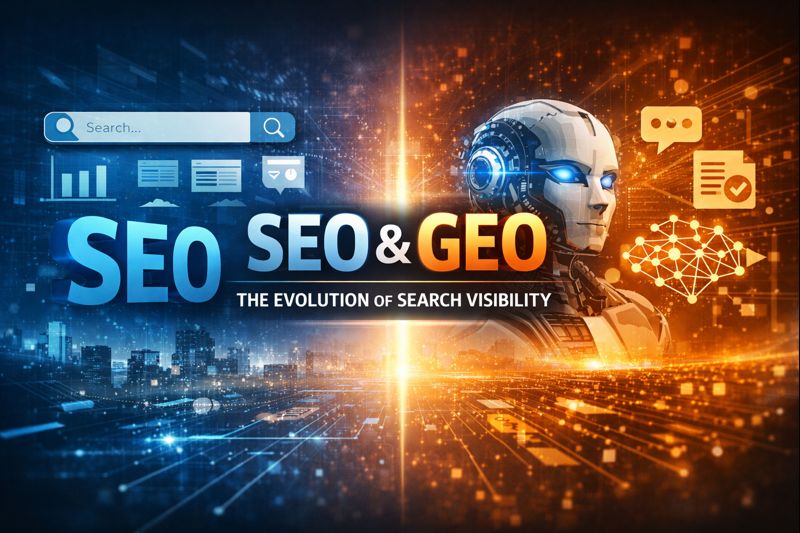
For years, SEO (Search Engine Optimization) was the undisputed king of digital visibility. Rank on Google, dominate keywords, and traffic follows. But the rules of the game are changing fast. Today, visibility is no longer just about ranking on search engines it’s about being understood, trusted, and referenced by AI systems.
This is where GEO (Generative Engine Optimization) enters the picture.
At DGforce, we see SEO and GEO not as competing strategies, but as two layers of the same visibility stack one built for humans searching, the other built for machines generating answers.
What Is SEO (and Why It Still Matters)
SEO is the practice of optimizing websites and content so they rank higher in search engine results pages (SERPs). It focuses on helping search engines understand:
-
What your content is about
-
How relevant it is to specific queries
-
How authoritative and trustworthy your site appears
Classic SEO pillars include:
-
Technical SEO (site speed, structure, indexing)
-
On-page SEO (keywords, headings, internal links)
-
Off-page SEO (backlinks, mentions, authority)
Despite all the hype around AI, SEO is far from dead. Google still drives massive traffic, especially for:
-
Transactional searches
-
Local intent
-
Research and comparison
-
News and time-sensitive topics
However, SEO alone is no longer enough.
The Shift: From Search Engines to Answer Engines
Users are changing how they search.
Instead of typing:
“Best cybersecurity risk assessment services”
They now ask:
“Which companies provide reliable cybersecurity risk assessments?”
And increasingly, they ask AI systems directly:
-
ChatGPT
-
Google SGE
-
Bing Copilot
-
Perplexity
-
Claude
These systems don’t just show links.
They generate answers.
And that changes everything.
What Is GEO (Generative Engine Optimization)?
GEO is the practice of optimizing content, brands, and digital assets so they are:
-
Referenced
-
Cited
-
Summarized
-
Recommended
by generative AI systems.
Unlike SEO, GEO is not about ranking positions.
It’s about being included in the model’s answer.
If SEO is about “Can users find you?”
GEO is about “Will AI mention you?”
Key Differences Between SEO and GEO
| SEO | GEO |
|---|---|
| Optimized for search engines | Optimized for AI models |
| Keyword-driven | Context- and entity-driven |
| Rankings matter | Mentions matter |
| Traffic focused | Influence and authority focused |
| Page-level optimization | Brand and knowledge-level optimization |
SEO targets algorithms that retrieve documents.
GEO targets systems that synthesize knowledge.
How AI Decides What to Mention
Generative AI models don’t think like search engines. They rely on:
-
Repeated brand mentions across authoritative sources
-
Clear topical authority
-
Structured, factual content
-
Consistent positioning
-
Trust signals (expertise, citations, clarity)
This means:
-
One perfectly optimized page is not enough
-
You need ecosystem presence, not just website presence
Blogs, articles, press, documentation, expert commentary, and educational content all feed into GEO.
Why GEO Is Critical for Cyber, Risk & Intelligence Brands
In fields like cybersecurity, risk analysis, intelligence, and strategic consulting, users often ask high-trust questions, such as:
-
“Who are the leading cybersecurity risk assessment firms?”
-
“What frameworks are used for cyber risk impact analysis?”
-
“How do organizations assess operational cyber exposure?”
AI systems prefer:
-
Clear frameworks
-
Defined methodologies
-
Expert-level explanations
-
Brands that sound authoritative, not promotional
This is where DGforce-style positioning becomes a competitive advantage.
SEO + GEO: The Combined Strategy
The future is not SEO or GEO — it’s SEO + GEO.
A modern visibility strategy should include:
1. Authority-First Content
Content that explains concepts deeply:
-
Risk frameworks
-
Methodologies
-
Use cases
-
Strategic implications
Not just “service pages”.
2. Entity Optimization
Clearly define:
-
Who you are
-
What you specialize in
-
What problems you solve
Across your site, content, and digital footprint.
3. Structured, AI-Readable Writing
-
Clear headings
-
Definitions
-
Lists and frameworks
-
Consistent terminology
AI loves clarity.
4. Thought Leadership Distribution
Visibility beyond your website:
-
Articles
-
Professional platforms
-
Industry commentary
-
Educational content
AI models learn from patterns, not campaigns.
Common Mistakes Companies Make
-
Over-optimizing keywords, under-explaining value
-
Writing for algorithms instead of understanding
-
Ignoring brand authority signals
-
Treating AI visibility as “future work”
In reality, GEO is happening now, whether you prepare for it or not.
Visibility Is Becoming Strategic
SEO was once a marketing tactic.
GEO is becoming a strategic positioning discipline.
The brands that win will not be the loudest — but the clearest, most authoritative, and most referenced.
At DGforce, we believe the future belongs to organizations that understand how humans search, how machines reason, and how influence is generated in both worlds.
SEO gets you found.
GEO gets you remembered.
And together, they define modern digital power.

Ariel Gal is a digital strategist specializing in scalable web platforms, SEO architecture, automation, and AI-enabled growth. His work focuses on turning complex digital systems into reliable business infrastructure.