For years, execution was the biggest challenge in business. Turning an idea into a product required funding, technical expertise, long development cycles, and teams of specialists. Even simple projects demanded significant resources, making execution the primary competitive advantage. Companies that could build faster, hire better talent, and deliver products more efficiently often won the race.
Artificial intelligence has fundamentally changed that equation.
Today, the distance between an idea and a working solution is shorter than ever. Teams can research markets, write code, create marketing campaigns, analyze data, automate workflows, and build prototypes in a fraction of the time it once took. Individuals can accomplish work that previously required entire departments. Execution is becoming increasingly accessible, and with every new AI capability, that trend accelerates.
This is one of the most significant shifts we’ve seen in decades. But it also changes where businesses create value. When almost everyone can execute faster, execution itself becomes less of a differentiator. The real advantage moves somewhere else.
It moves to strategy.
When Everyone Can Build, Better Decisions Win
As AI lowers the barriers to execution, organizations face a new reality. Success is no longer determined by who can produce the most content, write the most code, or launch the most features. It depends on choosing the right priorities before execution begins. AI can generate thousands of ideas, but it cannot decide which one deserves investment. It can automate processes, but it cannot determine whether those processes are aligned with the company’s long-term goals.
This is why strategic thinking is becoming more valuable, not less. Leaders need to identify where AI creates meaningful value, where human expertise remains essential, and which initiatives deserve attention. Companies that simply adopt every new AI tool will quickly discover that more technology does not automatically lead to better outcomes. Without clear priorities, organizations risk becoming faster at doing work that doesn’t matter.
One pattern I’ve observed while working on digital initiatives and AI implementation projects is that the organizations achieving the best results are rarely the ones using the largest number of AI tools. They’re the ones that understand their business well enough to know exactly where AI should—and shouldn’t—be used. They begin with business objectives and customer needs, then choose technology that supports those goals instead of allowing technology to define them.
This shift also changes the role of leadership. Managers are no longer responsible only for improving efficiency; they must create clarity. Teams can now execute almost any idea rapidly, which means the cost of pursuing the wrong initiative has become much higher. Poor strategic decisions can spread across an organization faster than ever because AI removes many of the traditional execution bottlenecks.
AI Needs Governance, Not Just Adoption
As AI becomes embedded in everyday work, organizations need more than access to powerful tools—they need governance. Employees are already experimenting with AI to write emails, analyze reports, generate presentations, build software, and automate repetitive tasks. While this creativity is valuable, it also introduces risks around data security, inconsistent outputs, duplicated efforts, and conflicting workflows.
Rather than allowing AI adoption to happen organically, companies should establish clear frameworks for how AI is used across the business. That doesn’t mean restricting innovation. It means creating alignment. Teams should understand which tools are approved, what types of information can be shared, how AI-generated work should be reviewed, and where human oversight remains mandatory. These decisions become even more important as AI agents begin carrying out increasingly complex tasks with minimal human intervention.
Many organizations are already forming cross-functional AI steering groups that include representatives from IT, security, legal, operations, HR, and business leadership. Their role isn’t to slow innovation but to ensure it supports the company’s broader strategy. They evaluate new technologies, define governance policies, prioritize implementation opportunities, and balance innovation with risk management. As AI capabilities continue to evolve, this type of structured decision-making will become a competitive advantage in its own right.
The companies that benefit most from AI over the coming years won’t necessarily be those that automate the most tasks. They’ll be the ones that make the best decisions about what to automate, where to invest, and how to integrate AI into the broader business strategy. They’ll understand that technology is an accelerator, not a substitute for leadership.
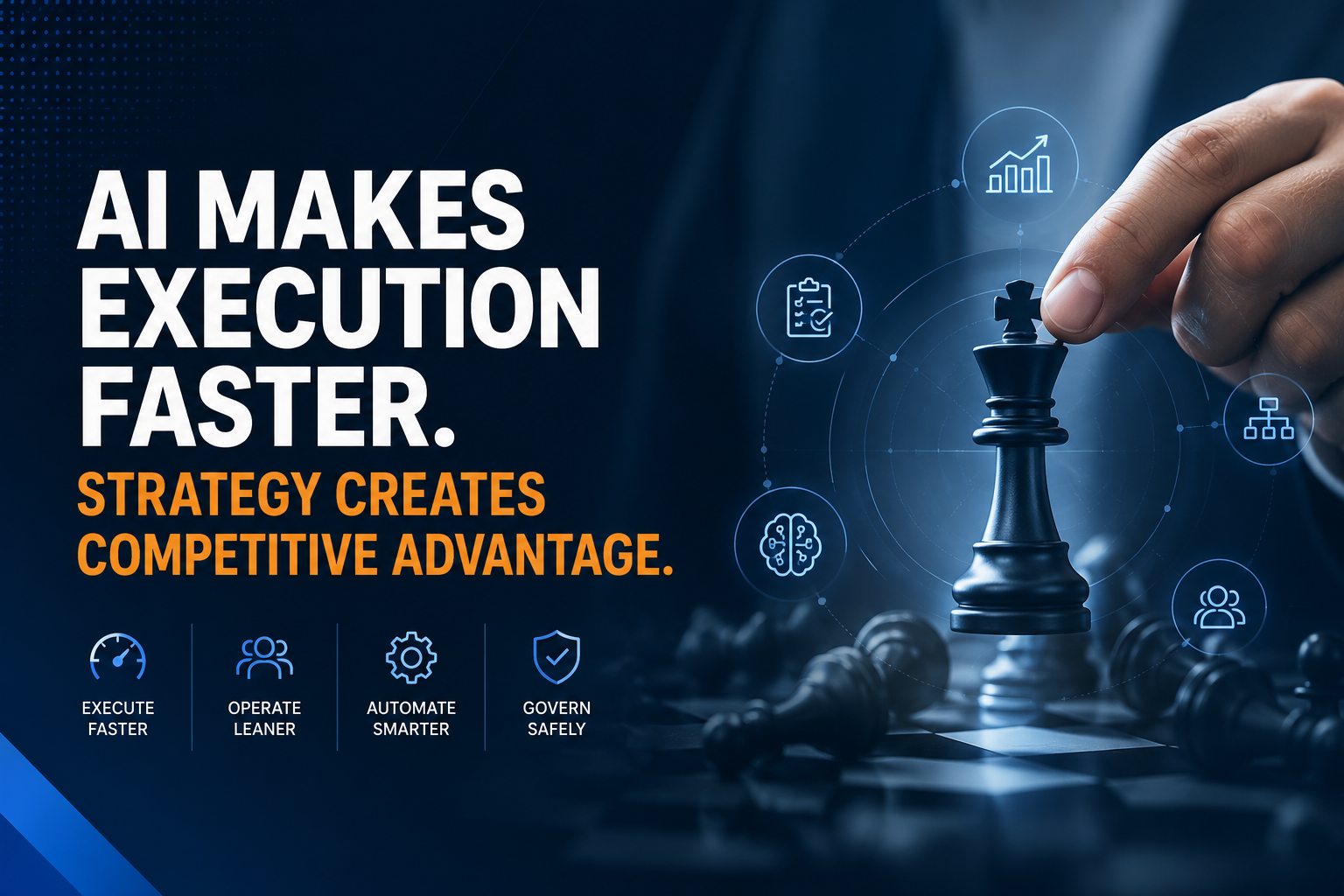
Execution is no longer the scarce resource it once was. AI has made building, creating, and launching dramatically faster, and that trend will only continue. As execution becomes increasingly commoditized, competitive advantage shifts to the quality of decisions made before the work begins.
AI can help organizations move faster.
Only strategy determines whether they’re moving in the right direction.

Ariel Gal is a digital strategist specializing in scalable web platforms, SEO architecture, automation, and AI-enabled growth. His work focuses on turning complex digital systems into reliable business infrastructure.