AI is no longer a tool you “add” to your marketing stack. In 2026, the highest-performing B2B teams design their growth systems around AI from day one. This shift from tool-first to system-first marketing is what separates scalable organizations from teams stuck in manual execution and fragmented workflows.
An AI-first marketing stack is not about replacing people. It’s about designing a connected system where data flows cleanly, decisions are assisted by AI, and execution is automated wherever possible without losing strategic control.
This guide breaks down how to build an AI-first B2B marketing stack in 2026, layer by layer, with practical architecture you can adapt to your business.
What “AI-First” Really Means
Most companies use AI as a feature:
Writing social posts
Generating ads
Summarizing reports
An AI-first stack means AI is part of the core operating system of marketing:
AI assists strategy, not just execution
AI connects systems, not just creates content
AI improves decision quality, not just speed
Instead of asking, “Which AI tool should we use?”
You design workflows where AI supports each stage of the customer journey.
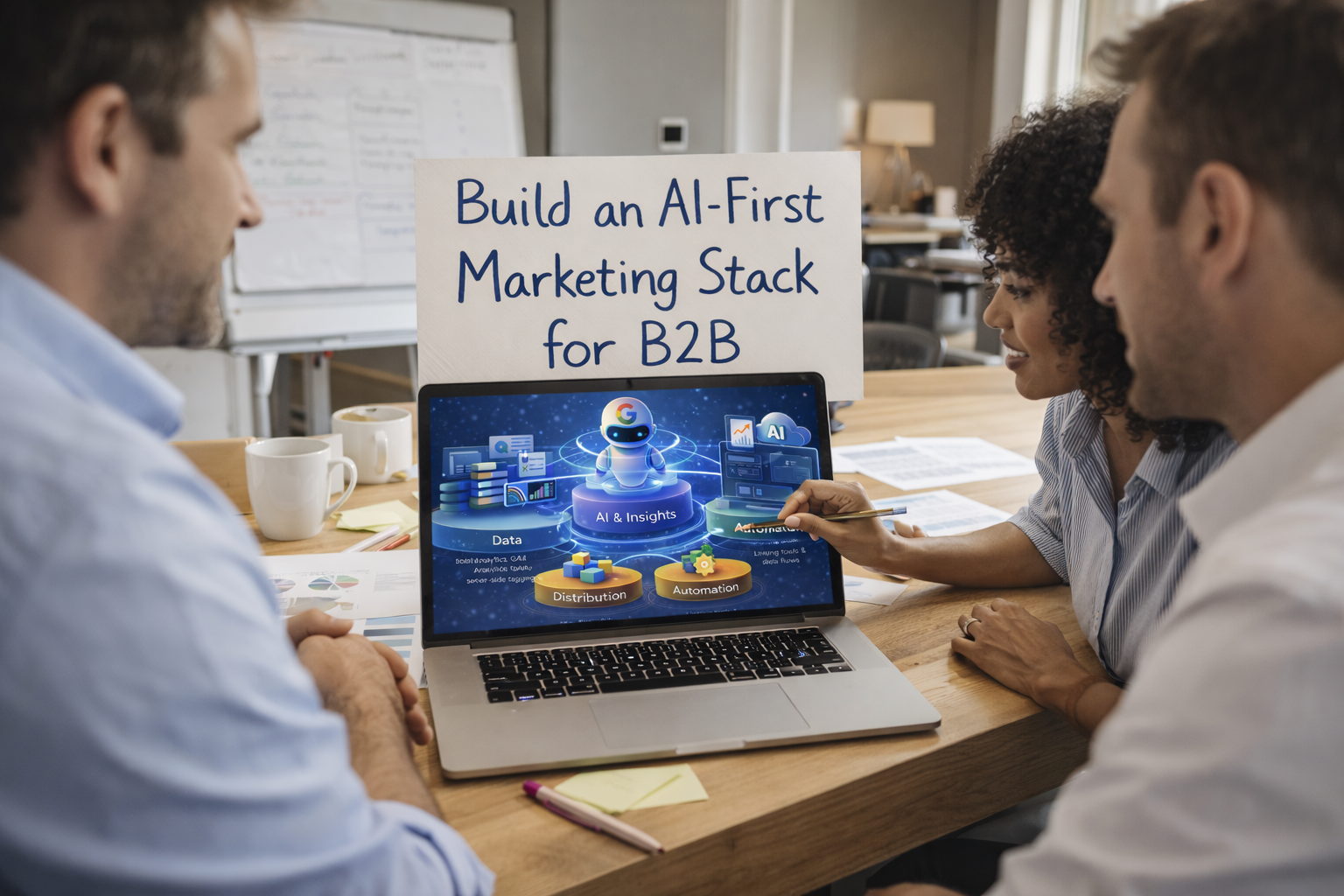
The 5-Layer AI-First Marketing Stack
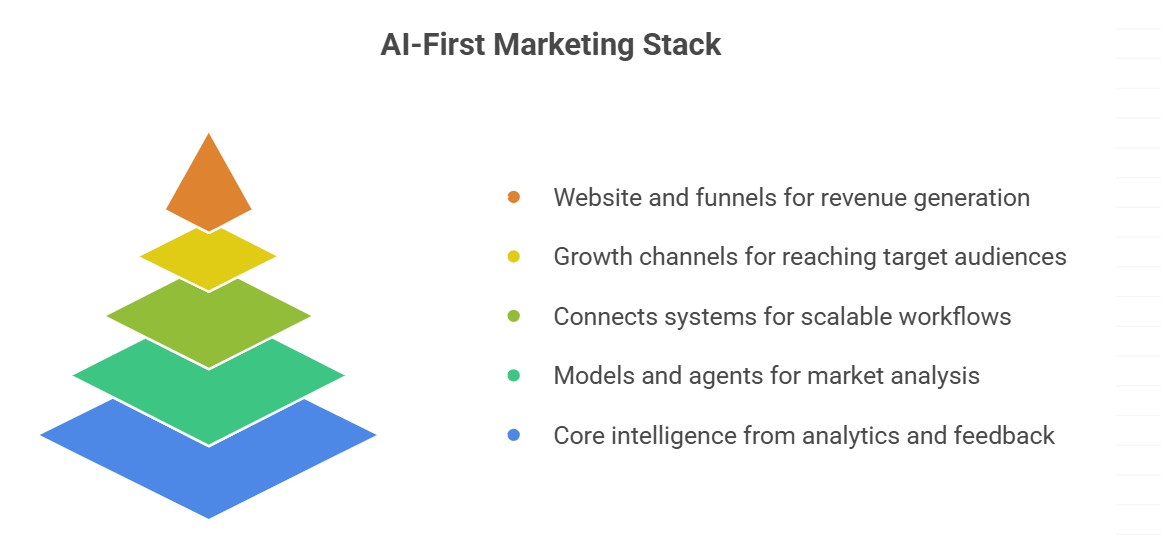
1. Data & Signal Layer (Your Intelligence Core)
AI is only as good as the data it receives. This layer defines what your system “knows.”
Core components:
Analytics: GA4, server-side tracking
CRM: HubSpot, Salesforce, Pipedrive
Product usage data
Customer feedback (forms, support tickets)
AI Role:
Pattern detection
Funnel analysis
Anomaly detection
Lead quality scoring
If your tracking is broken, your AI insights will be wrong.
This is where many AI-first stacks quietly fail.
2. AI & Intelligence Layer (Your Decision Engine)
This is where models and agents live.
Use cases:
Market analysis
Persona refinement
Content planning
Forecasting conversion impact
Competitive intelligence
Instead of running one-off prompts, design persistent AI agents that:
Monitor performance
Flag anomalies
Propose optimizations
In 2026, teams use AI not as a chatbot but as a decision co-pilot.
3. Automation & Orchestration Layer (Your Workflow Engine)
This layer connects systems.
Typical automations:
New lead → enrichment → CRM tagging
New content → SEO optimization → publishing
Paid ad performance dip → alert → creative refresh
Support ticket trend → content opportunity
The goal is not “no humans.”
The goal is no repetitive manual work.
This is where growth systems become scalable.
4. Distribution Layer (Your Growth Channels)
This is where output becomes reach:
SEO & GEO (AI Overviews visibility)
Paid acquisition (search, social, native)
Email & lifecycle campaigns
Partnerships & marketplaces
AI Role:
Creative variation testing
Budget reallocation recommendations
Channel performance forecasting
Messaging adaptation by segment
AI-first distribution is about adaptive growth, not fixed campaigns.
5. Conversion & Experience Layer (Your Revenue Engine)
Your website, funnels, and onboarding flows must support both:
Human visitors
AI-mediated discovery (AI search, assistants, agents)
Key elements:
Structured content
Clear positioning
Frictionless UX
Conversion tracking integrity
AI helps analyze drop-off points, segment intent, and suggest experience improvements — but only if your infrastructure is sound.
A Simple AI-First Stack Example (B2B SaaS)
Data: GA4 + CRM + product events
AI: Strategy agent for funnel analysis
Automation: Lead enrichment + scoring
Distribution: SEO + paid search + LinkedIn
Conversion: AI-assisted landing page optimization
This creates a feedback loop:
Data → AI insight → Automation → Distribution → Conversion → Data
That loop is your growth engine.
Common Mistakes in AI-First Marketing
1. Tool overload
More tools ≠ better systems.
Disconnected tools create operational debt.
2. No data governance
If tracking is weak, AI recommendations will be misleading.
3. Automating broken funnels
Automation amplifies what already exists — good or bad.
4. Replacing strategy with prompts
AI supports strategy. It does not replace leadership.
How to Start (Without Overengineering)
Map your current stack
Identify your biggest operational bottleneck
Add AI to one workflow
Measure impact
Expand only when value is proven
AI-first growth is built in layers, not in one sprint.
The winners in 2026 won’t be the companies using the most AI tools.
They’ll be the ones designing AI-native systems that connect insight, execution, and growth into a single operating model.
AI-first marketing is not about speed alone.
It’s about precision, leverage, and control at scale.

Ariel Gal is a digital strategist specializing in scalable web platforms, SEO architecture, automation, and AI-enabled growth. His work focuses on turning complex digital systems into reliable business infrastructure.