The AI revolution is no longer about novelty it’s about integration.
By 2026, Google has moved beyond isolated experimental tools and toward a unified, agent-driven AI ecosystem embedded directly into how people work. AI now lives inside code editors, analytics dashboards, design tools, and everyday productivity apps.
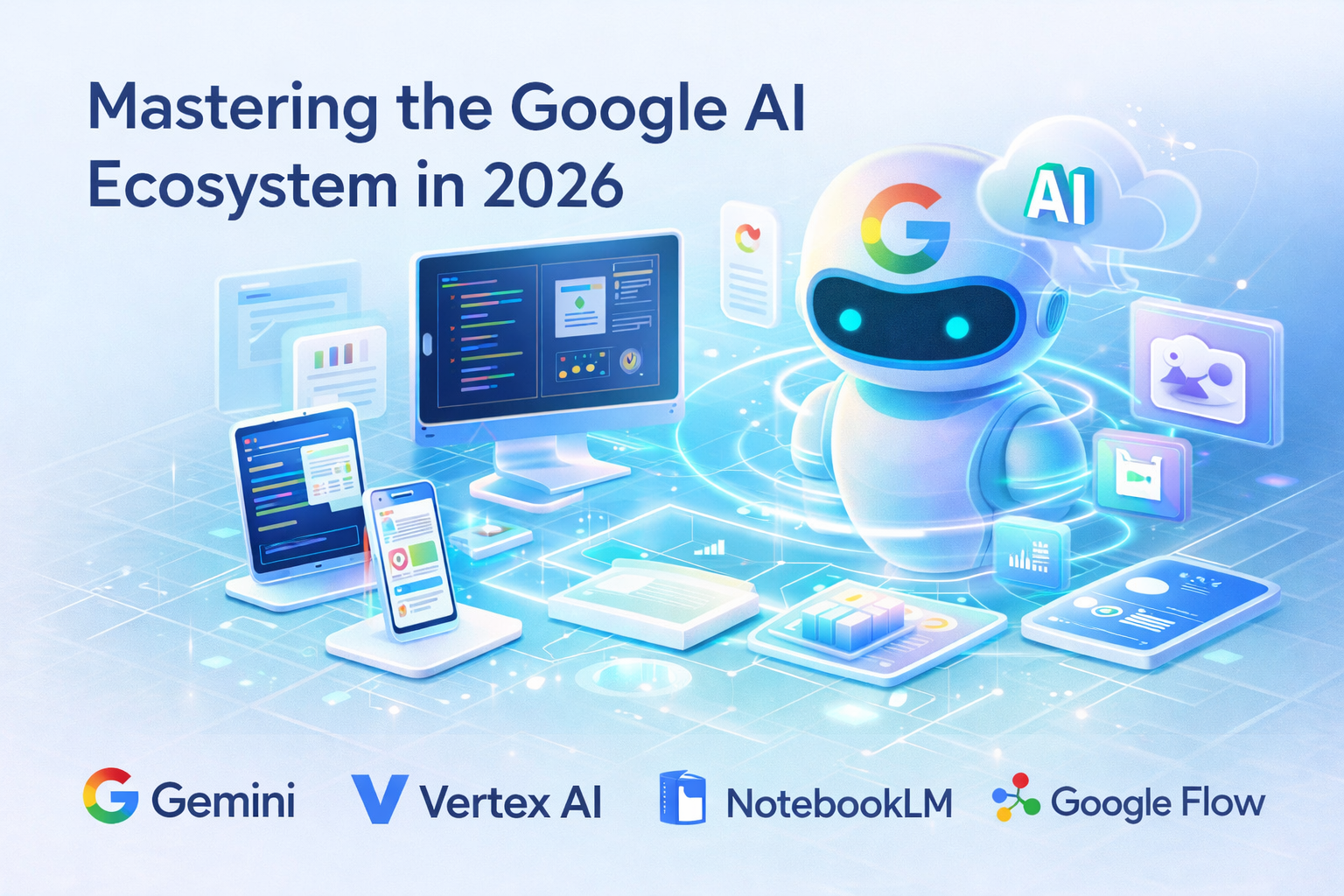
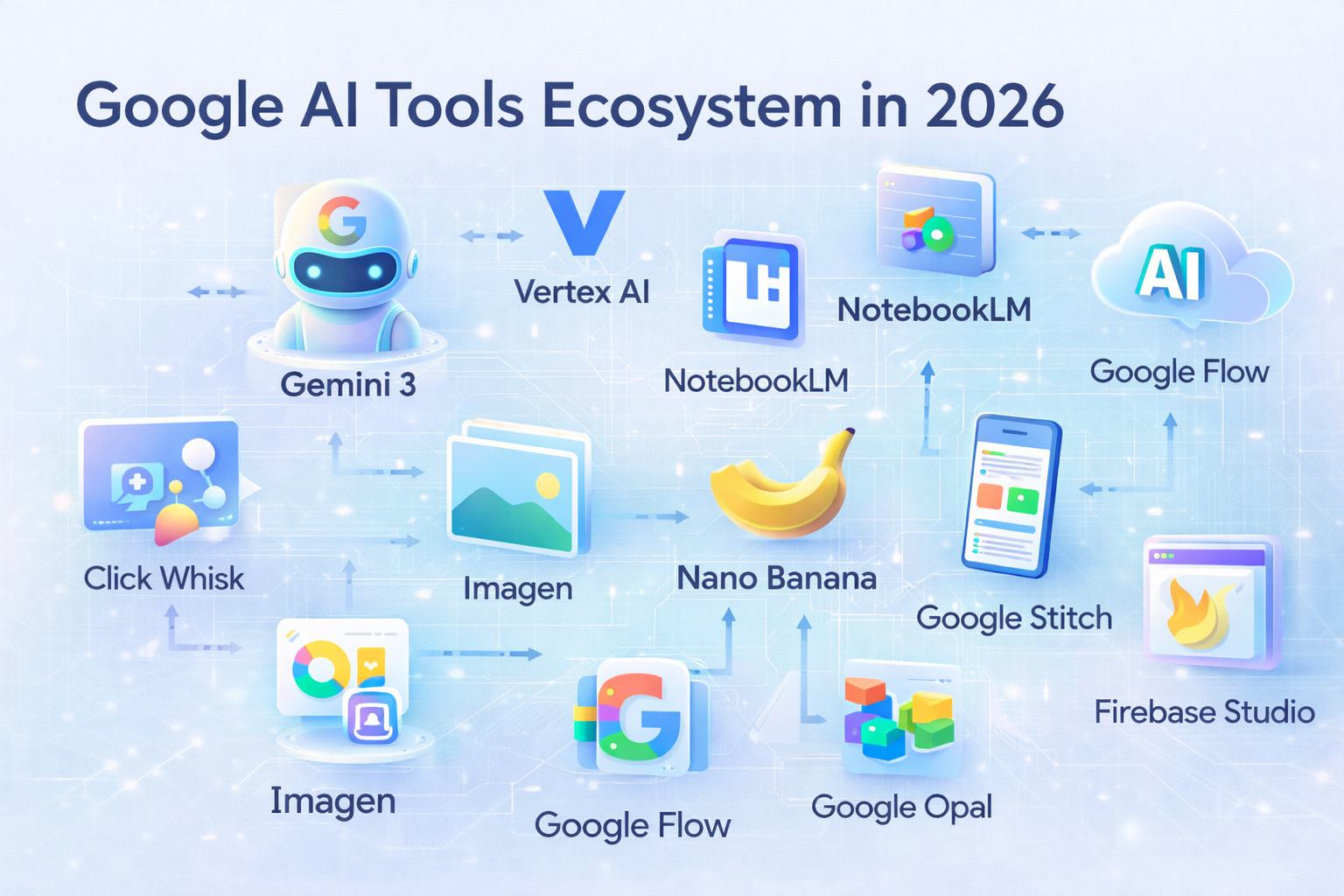
Staying ahead no longer means learning a single tool. It means understanding how platforms like Gemini, NotebookLM, Vertex AI, and Google Flow work together to automate complex workflows that once took days or even weeks.
This guide breaks down the most important components of Google’s AI ecosystem in 2026 and explains how businesses, developers, and creators can use them to build faster, work smarter, and scale with precision.
1. The Core Engines: Gemini and Vertex AI
At the center of Google’s AI strategy are two complementary platforms: Gemini and Vertex AI. While they overlap in capability, they serve different audiences and use cases.
Gemini: The Universal Productivity Agent
Gemini (now in its third generation) has evolved from a conversational assistant into a true agentic platform. Rather than responding to single prompts, Gemini can execute multi-step tasks across Google’s ecosystem.
For example, Gemini can:
Analyze sales data in Google Sheets
Draft a performance summary in Google Docs
Suggest next actions
Schedule a follow-up meeting in Google Calendar
This shift makes Gemini less of a chatbot and more of a workflow orchestrator.
Best for:
Daily productivity, cross-app automation, ideation, and fast decision support.
Vertex AI: The Developer’s Command Center
Vertex AI is designed for teams building custom AI solutions. It provides access to Google’s foundational models and tooling to fine-tune, deploy, and manage AI systems at scale.
In 2026, Vertex AI includes an expanded Model Garden, where developers can test open-source models alongside Google’s proprietary models, customize behavior, and deploy production-ready agents.
Best for:
Custom chatbots, machine learning pipelines, internal AI tools, and enterprise-grade applications.
2. Deep Research & Knowledge Management: NotebookLM
For accuracy-focused work, NotebookLM has become one of Google’s most valuable tools.
NotebookLM allows users to upload:
PDFs
Google Docs
Website URLs
Internal documentation
It then builds a private knowledge graph based only on those sources.
Why it matters
It does not crawl the open web
Answers are grounded in provided documents
Citations are transparent and verifiable
This makes NotebookLM especially useful for research, compliance, strategy, and technical documentation.
The 2026 Edge
New Audio Overviews allow dense reports or technical material to be converted into podcast-style briefings ideal for executive reviews or on-the-go learning.
3. Creative Execution: From Concept to Output
Google’s creative AI tools in 2026 are focused on closing the gap between idea and production.
Visual Creation: Imagen and Whisk
Imagen generates high-quality, photorealistic images
Whisk allows images themselves to be used as prompts
Instead of describing a concept in text, users can upload sketches, mockups, or reference images and ask the AI to refine, extend, or evolve them.
This dramatically improves creative accuracy and iteration speed.
Video Generation: Google Flow and Nano Banana
Video creation is no longer a bottleneck.
Nano Banana Pro generates cinematic B-roll and realistic video clips from short descriptions
Google Flow acts as an AI-powered editing environment, handling sequencing, transitions, and length adjustments
Together, they allow teams to move from concept to publishable video content without traditional production pipelines.
4. Accelerated Development: Stitch and Firebase Studio
At DGForceX, development speed is a constant priority. Google’s 2026 development stack focuses on “No-Code to Pro-Code” workflows.
Google Stitch
Stitch allows developers and product teams to describe an interface in plain language. It then generates:
UI layouts
Color systems
Interactive components
These can be exported directly to Figma or React for further refinement.
Firebase Studio
Firebase Studio provides a browser-based environment for building and deploying full-stack applications. It includes:
Hosting
Databases
Authentication
AI integrations
This reduces friction between prototyping and production.
5. Marketing & Business Automation
For marketers and small businesses, Google’s AI tools now support end-to-end campaign execution.
Google Pomelli
Pomelli focuses on creative and campaign ideation:
Social posts and captions
Ad copy variations
Campaign concepts
Google Opal
Often described as Google’s answer to Zapier, Opal allows users to visually connect services and automate workflows.
Example:
Automatically summarize Gmail attachments using Gemini and save them to a structured Drive folder.
This level of automation significantly reduces manual overhead.
The 2026 Strategy: How to Start Without Overload
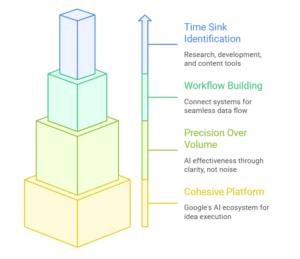
The biggest mistake organizations make in 2026 is AI overload trying to use everything at once.
Instead, take a structured approach:
Identify the time sink
Research → NotebookLM
Development → Firebase Studio
Content → Gemini or ImagenBuild workflows, not prompts
Use tools like Opal to connect systems so outputs feed into each other.Prioritize precision over volume
AI is most effective when it reduces effort and increases clarity not when it generates noise.
Google’s AI ecosystem in 2026 is no longer a collection of tools. It’s a cohesive execution platform designed to move ideas from concept to reality faster than ever.
For businesses, developers, and creators, these tools offer real leverage whether you’re launching a SaaS product, scaling content, or optimizing internal operations.
The advantage doesn’t come from using more AI.
It comes from using the right AI systems, in the right order, for the right outcomes.

Ariel Gal is a digital strategist specializing in scalable web platforms, SEO architecture, automation, and AI-enabled growth. His work focuses on turning complex digital systems into reliable business infrastructure.